A Journaling Exercise: From Education to Independent Judgment (With Audio)
STRATEGIC Journaling Exercise: Moving From Education to Judgment
(WITH AUDIO COMPANION)
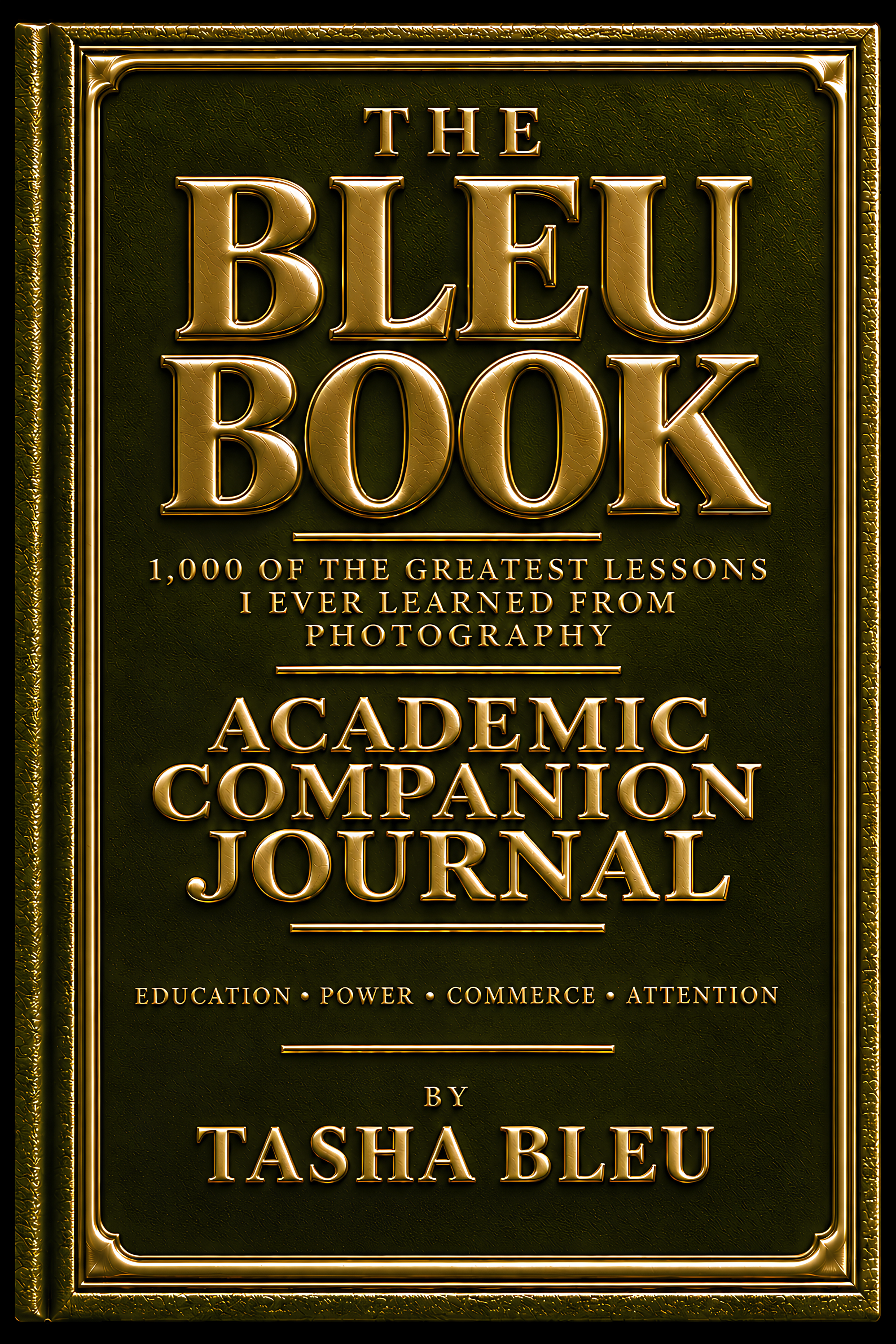
THE BLEU BOOK — ACADEMIC COMPANION JOURNAL
Preliminary Cover Design Concept | October 2026
Creative Direction & Publishing Concept: Tasha Bleu LLC
© 2026 Tasha Bleu LLC. All rights reserved.
Repeatable Journaling Exercise
From Education to Independent Judgment
Before moving to the next lesson, consider how this conversation connects to the decisions you are preparing to make. Use your accompanying journal to examine what you want from your education, how you evaluate opportunities, and what you intend to build beyond graduation.
The purpose is not to reproduce Tasha Bleu’s conclusions. It is to develop your own discernment.
Write in specific terms. Where possible, name an actual opportunity, commitment, project, or unanswered question rather than describing what you might do in an ideal situation.
1. Define the Reference You Need
What would make a foundational reference useful to you beyond graduation—and worthy of returning to as your responsibilities change?
Consider:
- Which decisions do you feel prepared to make independently? Which still leave you uncertain?
- What would you want to consult before accepting a position, entering a partnership, or committing your own money?
- What distinguishes a useful principle from a memorable statement that offers little practical direction?
- What would make you trust a reference? What would lead you to challenge it or seek another perspective?
- How might your needs change between your first professional role and your first leadership responsibility?
Complete these statements:
The education I want to carry beyond graduation must help me __________.
A question I do not yet know how to answer is __________.
I would return to a lesson if it helped me __________.
Examine One Opportunity Through Four Lenses
How might Education, Power, Commerce, and Attention shape the way you evaluate your next opportunity?
Choose one real opportunity: an internship, employment offer, freelance assignment, collaboration, graduate program, or independent venture. Examine it through the four pillars that organize Lessons 004–166.
Education: What do I need to understand?
- What do I know about this opportunity, and how do I know it?
- Which details have I verified? Which am I assuming?
- What skills, knowledge, or experience could I gain?
- What question am I reluctant to ask because I think I should already know the answer?
Power: Who can decide?
- Who can approve the arrangement, change its terms, or bring it to an end?
- Who would evaluate my work, and what authority would I have?
- Are the person making the promises and the person making the decisions the same?
- What influence, alternatives, or boundaries would I bring?
Commerce: What is being exchanged?
- What would I contribute in time, labor, ideas, money, or access?
- What would I receive, and which parts of that exchange are clearly defined?
- What questions remain about compensation, expenses, ownership, credit, or future use of my work?
- What would I need clarified before agreeing?
Attention: What will this require of me?
- How much preparation, execution, follow-up, and ongoing availability would this involve?
- What would I postpone or decline to participate?
- Am I drawn to its substance, its visibility, or the approval I associate with it?
- Does it support the direction I want to pursue?
Finish with a short assessment:
The strongest reason to pursue this opportunity is __________.
The most important unanswered question is __________.
Before committing, I need to __________.
Separate Enthusiasm From Verification
Where might personal enthusiasm or affinity influence your judgment, and what would you need to verify before making a commitment?
Recall an occasion when you felt excited by an opportunity or impressed by the person offering it. The experience may have ended well, poorly, or without a clear outcome.
Reflect:
- What first attracted me: the work, the relationship, the compensation, the status, or the possibility of belonging?
- What did I know about the other party’s ability to deliver?
- Did I interpret friendliness, familiarity, or shared interests as evidence of reliability?
- Were there questions I avoided because I did not want to disturb the relationship?
- Was any discomfort about an ordinary difference in personality—or about specific conduct that concerned me?
- What would I want documented or independently clarified if the same opportunity appeared today?
Create Two Columns in Your Journal

Describe your expectations and impressions.
Record the facts, commitments, documents, or observed actions supporting them.
Then answer:
What would remain attractive about this opportunity if personal approval were removed from the equation?
Distinguish Doing the Work From Sustaining It
What is the difference between performing valuable work and building a structure that can sustain it beyond your direct involvement?
Choose a project, service, initiative, or body of work you care about.
Consider:
- Which parts currently depend on your personal presence?
- Which require your judgment, and which could be documented or shared?
- What would another person need to continue the work responsibly?
- Where are the instructions, files, permissions, budgets, and key decisions recorded?
- If you stepped away for a month, what would continue—and what would stop?
- Do you want to remain primarily a hands-on practitioner, lead others, develop assets, or combine these roles?
Do not assume that growth must mean building a large organization. Describe the working model you actually want.
Complete:
The work I want to remain personally involved in is __________.
The responsibility I could document, share, or delegate is __________.
One structure that would make this work more sustainable is __________.
Engage With the Author Without Judgment
How can you engage seriously with an author’s experience without treating their conclusions as unquestionable authority?
Select one statement from the interview that resonated with you—and one you would question.
For each, ask:
- What is the author describing: an experience, an interpretation, a principle, or a proposed course of action?
- What makes the statement persuasive to me?
- What evidence or perspective would help me evaluate it?
- Under what circumstances might it apply differently?
- Whose experience is not represented?
- What would change my mind?
Write a brief response beginning:
I find this idea useful because __________. Its limits may be __________. Before applying it in my own circumstances, I would want to understand __________.
Then consider the collection’s “new age Bible” metaphor:
What would make a book worth returning to without placing it beyond criticism?
Closing Entry: Turn Reflection Into a Decision
Review what you have written. Identify:
- One assumption you need to test.
- One question you need to ask.
- One boundary you need to clarify.
- One structure you need to establish.
- One idea you want to revisit after gaining more experience.
Choose one action you can take within the next seven days.
State what you will do, when you will do it, and what you hope to learn.
End your entry with:
I do not need certainty about everything before moving forward. For my next decision, I need greater clarity about __________. My next step is __________.
Return to this entry after the decision or experience has unfolded. Record what you understood accurately, what surprised you, and what you would now approach differently.
Second Interview with the Author
The Vision: An Education You Can Carry
TEAM MEMBER: Tasha Bleu, let’s start with the larger ambition. You’re building a six-volume collection called THE BLEU BOOK: 1,000 of the Greatest Lessons I Ever Learned from Photography. But you’re positioning it for people who may never pick up a professional camera. What are you actually creating?
TASHA BLEU: A reference for learning how to move through the world with your eyes open.
Photography is where I gathered the lessons. It is not the limit of who can use them.
A camera brought me into environments where I had to understand people, institutions, money, ownership, access, and responsibility—sometimes simultaneously, sometimes under pressure. The photograph was the assignment on paper. The deeper education was learning what made the assignment possible, who controlled its value, and what happened after everyone left the room.
I want to translate that education into something a student can carry into whatever comes next.
Not everyone will become a photographer. Everyone will have to make decisions about their time, their work, their relationships, and their future.
TEAM MEMBER: You’ve described the ambition as a “new age Bible for every outbound college student.” That is a strong positioning statement. What does it mean to you?
TASHA BLEU: I mean discernment.
I am using “Bible” as a metaphor for a foundational reference—something you keep, revisit, question, annotate, and return to when your circumstances change. I am not presenting myself as a religious authority or asking anyone to replace their faith.
Nor am I asking readers to treat my experience as infallible.
The ambition is to create a collection that stays useful beyond the semester in which someone first encounters it. A student might read a lesson before an internship and understand it one way. Five years later, while negotiating a partnership or building a company, that same lesson may reveal an entirely different dimension.
That is the kind of relationship I want readers to have with these books: not passive agreement, but ongoing application.
TEAM MEMBER: So “new age” means contemporary, rather than a prescribed spiritual movement?
TASHA BLEU: Exactly. A reference for the conditions this generation is entering.
The collection can make room for questions of purpose, inheritance, and moral responsibility without requiring every reader to share the same beliefs.
You can come to these books from a religious tradition, a secular perspective, or a place of uncertainty. The practical questions remain: What are you building? What are you agreeing to? What do you own? What will your decisions leave behind?
Volume One: Lessons 000–166
TEAM MEMBER: What is your plan for the first volume?
TASHA BLEU: Volume One establishes the reader’s operating foundation.
Lessons 000 through 003 explain where the work begins: the meaning of an absent record, the responsibility of bearing witness, and the realization that something valuable can disappear if no one takes responsibility for preserving it.
Then Lesson 004 makes a deliberate turn.
From that point through Lesson 166, the organizing pillars are Education, Power, Commerce, and Attention. The question shifts from “What happened to me?” to “What can someone else learn to recognize, evaluate, and do?”
I do not want the reader living inside my biography. I want them developing their own judgment.
TEAM MEMBER: The earlier manuscript contains personal history, but the revised direction says clearly that this is not a memoir. How do you reconcile those elements?
TASHA BLEU: By distinguishing the origin from the assignment.
The opening experiences explain why I began paying attention. They do not have to become the subject of every lesson that follows.
If I tell you something was lost, the useful next question is not simply how that loss felt. It is what system could prevent a similar loss, what responsibility was missing, or what another person can now do differently.
The opening establishes the stakes. The curriculum develops the response.
TEAM MEMBER: And the lessons are not meant to follow your career chronologically?
TASHA BLEU: No. Their sequence should serve understanding, not a timeline of my life.
A lesson from an early assignment may belong beside something I understood much later because they illuminate the same problem.
I want readers connecting patterns across situations. The setting may change from a production to a university, a corporate office, or a new venture. The underlying questions about authority, incentives, accountability, and ownership can still travel.
The Four Pillars
TEAM MEMBER: Walk us through Education, Power, Commerce, and Attention. How do you want those pillars to work together?
TASHA BLEU:
Education asks: What do I know, what am I assuming, and what do I need to verify?
Power asks: Who can make the decision, set the terms, grant access, or withhold it?
Commerce asks: How is value created, exchanged, compensated, and protected?
Attention asks: What deserves my focus—and what am I allowing to direct it?
I want students to examine all four rather than treating them as separate subjects.
Imagine receiving an exciting opportunity. Education helps you understand what is actually being offered. Power helps you identify who has authority to approve it. Commerce helps you examine compensation and obligations. Attention helps you decide whether the opportunity deserves the time it will consume.
That is the reading habit I want Volume One to develop: look beyond the headline.
TEAM MEMBER: Does that make the book a business manual?
TASHA BLEU: Business is part of it, but the ambition is broader.
I want the reader thinking about professional agency and human responsibility together.
How do you pursue income without surrendering every boundary? How do you build relationships without confusing approval with security? How do you preserve what matters without spending your entire life collecting things you never organize or protect?
Those are commercial questions, but they are also questions about how you live.
The Institutional Pivot
TEAM MEMBER: Lesson 004 separates personal affinity from enterprise governance. Why make that the first major pivot?
TASHA BLEU: Because I want to challenge two assumptions early.
The first is: “I like this person, so I do not need to examine the arrangement.”
The second is: “I do not feel personally connected to this person, so we cannot work together.”
Neither is the standard I want readers relying on.
The lesson asks them to examine competence, obligations, documentation, incentives, and accountability. Warmth can be welcome. It should not have to carry the entire structure of an agreement.
TEAM MEMBER: Where does that leave intuition and personal values?
TASHA BLEU: They remain important. But I want readers to become more precise about what they are responding to.
A personality mismatch is not the same as evidence of dishonesty. An uncomfortable conversation is not automatically an ethical violation. Equally, a charming presentation does not resolve a serious concern.
The point is not to ignore your judgment. It is to strengthen it.
And nothing in that lesson should be read as “accept anything if the paperwork looks impressive.” Some opportunities should be declined.
TEAM MEMBER: You also distinguish performing every assignment from building an enterprise. What should a graduating student take from that?
TASHA BLEU: First, that there is dignity in skilled work. I am not dismissing the practitioner who wants to remain hands-on.
I am asking the reader to recognize the model they are choosing.
Do you want to perform the work personally? Direct a team? Develop intellectual property? Build an organization? Combine those roles?
Those are different ambitions. They require different structures.
In my field, I want students to understand that operating a photography business can involve creative direction, production oversight, licensing, rights administration, and delegated execution—not only holding the camera.
The larger lesson is to stop letting the first task people pay you for define the outer boundary of your future.
Why the College Transition Matters
TEAM MEMBER: Why focus this positioning on students leaving college?
TASHA BLEU: Because I want the collection beside them at a moment of transition—not after every difficult lesson has already become expensive.
Picture the reader preparing to accept an offer, sign an agreement, enter a partnership, or put their name on something publicly. My ambition is for the book to help them pause and ask a better question.
What is expected of me?
What remains mine?
Who is accountable?
What have I not understood yet?
I am not promising a book that removes uncertainty. I want to create one that makes the reader more deliberate inside it.
TEAM MEMBER: Is this a criticism of college?
TASHA BLEU: No. It is a proposed companion to education, not a replacement for it.
I want students to carry their academic knowledge into lived decisions. I would welcome a professor challenging a lesson, a seminar testing its assumptions, or a student showing where an example needs a different interpretation.
A collection intended for serious study should invite that scrutiny.
“Foundational” should not mean beyond question.
TEAM MEMBER: What do you want someone to be able to do after reading Volume One?
TASHA BLEU:
Describe an opportunity without being overwhelmed by its presentation.
Identify where authority actually sits.
Separate personal enthusiasm from the terms of participation.
Recognize when they need qualified advice instead of guessing.
And begin thinking beyond immediate delivery: What am I creating that should remain useful, protected, and accessible later?
Those are the capabilities I want the lessons to cultivate—not claims that reading alone can confer expertise.
Building a Collection That Remains Useful
TEAM MEMBER: Why six volumes rather than one definitive book?
TASHA BLEU: Because I do not want to compress a thousand lessons into a collection of slogans.
Some ideas need a short, direct statement. Others need a case, a contradiction, a discussion, and room for the reader to work through the implications.
The six-volume structure gives the project space to develop.
Volume One establishes how to observe and evaluate. The collection as a whole carries the larger inquiry into creative independence, responsibility, ownership, and what survives us.
I want breadth without losing the discipline of a usable lesson.
TEAM MEMBER: How do the seminar questions and audio companions fit?
TASHA BLEU: I see them as different entrances into the same material.
The written lesson offers a concentrated argument. The seminar questions expose its tensions. The audio conversation can slow the argument down and examine what a reader might otherwise pass over.
For this project, I would rather someone question one lesson carefully than repeat ten of them fluently without knowing how they apply.
TEAM MEMBER: What would make the “Bible” positioning credible rather than simply ambitious marketing?
TASHA BLEU: The work has to earn its place on the reader’s desk.
The phrase cannot do that for it.
The lessons need clear distinctions, honest limits, strong editorial standards, and questions worth returning to. When something involves law, finance, or another specialized discipline, the material must acknowledge where education ends and qualified professional advice begins.
And the collection must leave room for revision. If I am asking students to update their thinking when evidence changes, the project has to demonstrate that same discipline.
The Final Assignment
TEAM MEMBER: Complete this sentence: “Every student leaving college should have a reference that…”
TASHA BLEU: “…helps them think before they surrender their time, attach their name, or sign away something they have not yet learned to value.”
TEAM MEMBER: And what do you want a reader to understand about you when they finish the first volume?
TASHA BLEU: That I did not write it to make them admire where I have been.
I wrote it to help them become more intentional about where they are going.
Photography taught me to notice what might otherwise disappear. This collection is my attempt to preserve the lessons—not just the images—and place them into someone else’s hands.
TEAM MEMBER: Then what is the invitation behind THE BLEU BOOK?
TASHA BLEU:
Do not inherit my conclusions without examining them.
Learn how to observe. Ask what supports a claim.
Understand the terms.
Protect what matters.
Know when to seek help and when to walk away.
Then build something you can take responsibility for.
That is what I want these six volumes to offer: not a substitute for your education, your beliefs, or your judgment, but a reference you can return to while developing all three.
Before You Continue
As you move on to the next lesson, consider these questions:
• What would make a foundational reference useful to you beyond graduation—and worthy of returning to as your responsibilities change?
• How might Education, Power, Commerce, and Attention shape the way you evaluate your next opportunity?
• Where might personal enthusiasm or affinity influence your judgment, and what would you need to verify before making a commitment?
• What is the difference between performing valuable work and building a structure that can sustain it beyond your direct involvement?
• How can you engage seriously with an author’s experience without treating their conclusions as unquestionable authority?
Volume One is an invitation to develop discernment, not simply collect advice. As the six-volume collection takes shape, read actively, question carefully, and consider how each lesson might inform the decisions, boundaries, and responsibilities you carry beyond the classroom.
HAVE 38 MINUTES TO GO DEEPER?
The Seminar Audio Companion
Join our editorial and research team for an in-depth critical dialogue analyzing the qualitative case studies and theoretical frameworks explored in this entry. This long-form companion examines the broader socioeconomic, legal, and documentary implications of the text, bridging written scholarship with oral analysis. While this seminar dialogue will soon be syndicated across major academic and audio distribution platforms, it is accessible directly here.
Press play to continue the analysis. ↓
Institutional & Pedagogical Notice
The analytical frameworks, qualitative case studies, historical interpretations, and professional methodologies presented in this publication reflect the independent scholarship and creative practice of Tasha Bleu LLC. They do not represent the official positions, policies, or endorsements of any commercial brands, academic institutions, corporate sponsors, or third-party organizations referenced herein. All content is published strictly for scholarly inquiry, historical documentation, curriculum integration, and educational instruction. This material does not constitute formal legal, corporate governance, financial, or investment counsel.
© 2026 Tasha Bleu LLC. All rights reserved.