Curricular Framework: Lessons 005–010
ONE THOUSAND of the Greatest Lessons I Ever Learned from Photography
Volume One: Education, Power, Commerce, and Attention (Curricular Block 004–166)
By Tasha BLEU
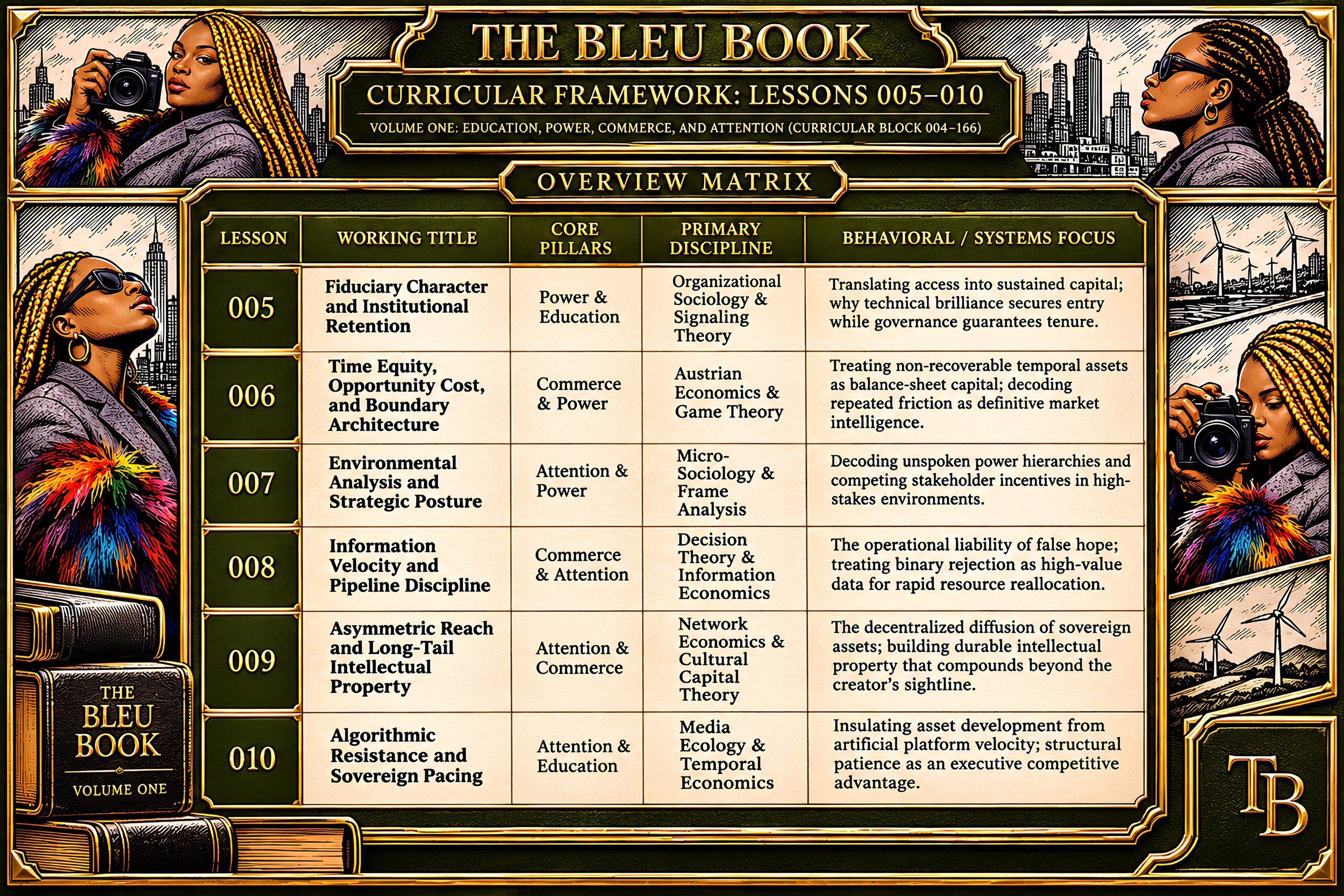
THE BLEU BOOK: CURRICULAR FRAMEWORK — LESSONS 005–010
Volume One: Education, Power, Commerce, and Attention
An Interdisciplinary Framework for Institutional Learning, Executive Decision-Making, and Creative Sovereignty
The next six lessons of THE BLEU BOOK: 1,000 of the Greatest Lessons I Ever Learned from Photography introduce an interdisciplinary curriculum examining how education, institutional power, economic decision-making, human behavior, and attention shape professional development and long-term intellectual capital.
Developed by Tasha Bleu through sixteen years of international commercial photography, creative direction, and institutional field experience, Lessons 005–010 translate practical observations into structured academic inquiries spanning organizational sociology, signaling theory, Austrian economics, game theory, decision theory, network economics, and media ecology.
© 2026 Tasha Bleu LLC. All rights reserved.
LESSON 005: Fiduciary Character and Institutional Retention
Subtitle: Converting Transient Cultural Access into Permanent Enterprise Sovereignty
Pillars: Power · Education
1. Point of Entry
Raw technical capability can unlock premier rooms, elite institutions, and lucrative opportunities, but it possesses zero retention value. Entering a room is an act of market introduction; being invited back is an audit of institutional character. In high-stakes enterprise, counterparties tolerate idiosyncratic talent only until their first operational breach. Long-term capital belongs exclusively to operators whose governance, confidentiality, and reliability match their craft.
2. Historical & Psychological Foundations
Historical Anchor: The shift from Renaissance patronage (where erratic genius was tolerated under aristocratic whim) to modern corporate governance and fiduciary duty, where institutional continuity demands predictability and systemic risk mitigation.
Psychological Anchor: Signaling Theory (Michael Spence) and Social Capital Theory (Pierre Bourdieu). Technical talent is an observable, surface-level signal. Discretion, operational discipline under pressure, and fidelity to contracts are high-cost, authentic signals of long-term counterparty fitness.
3. Curricular Case Analysis
The Operational Audit: What executive stakeholders actually track—treatment of junior crew, strict adherence to call times, protection of non-disclosure covenants, and transparent ownership of field errors without deflection.
The Fragility of the Brilliant Liability: Why enterprises systematically replace top-tier creative talent with dependable, second-tier operators when the former introduces reputational or scheduling volatility.
Institutional Equilibrium: Integrating creative excellence with ironclad corporate governance.
4. Pedagogical Deliverables
Key Takeaways: Talent opens doors; systems and character hold them open. Reputational equity compounds through operational predictability. Discretion is an unpriced enterprise asset.
Seminar Discussion Inquiries: How do institutional risk officers balance creative exceptionalism against counterparty reliability? In what ways does an unmanaged ego degrade operational margins?
LESSON 006: Time Equity, Opportunity Cost, and Boundary Architecture
Subtitle: Treating Non-Recoverable Temporal Assets as Enterprise Capital
Pillars: Commerce · Power
1. Point of Entry
Time is not equivalent to money; time is non-recoverable biological and operational capital. Capital lost can be re-earned through commercial transactions, but an hour wasted is permanently subtracted from your enterprise capacity. A delayed response or a rejected pitch is ordinary market friction. Repeated counterparty disregard, however, is definitive behavioral data. A sovereign operator extracts the lesson on the first occurrence and establishes an immediate perimeter.
2. Historical & Psychological Foundations
Historical Anchor: The development of Opportunity Cost in classical and Austrian economic thought (Friedrich von Wieser), formalizing the principle that the true cost of pursuing any misaligned transaction is the permanent loss of all higher-value alternatives.
Psychological Anchor: The Sunk Cost Fallacy (Daniel Kahneman & Amos Tversky) and Commitment Bias. Novice operators return repeatedly to deadlocked negotiations or uncooperative counterparties out of an irrational psychological compulsion to justify energy already expended.
3. Curricular Case Analysis
Friction as Information: Differentiating between standard administrative delays and systemic counterparty disrespect.
The Cost of Infinite Re-negotiation: How tolerating chronic unreliability dilutes focus, strains production infrastructure, and depresses enterprise billable rates.
Structural Boundary Architecture: Implementing non-negotiable operational triggers—advance deposits, strict cancellation windows, and unilateral walk-away clauses.
4. Pedagogical Deliverables
Key Takeaways: Repeated disregard is definitive intelligence, not an invitation to debate. Protecting your calendar preserves your balance sheet. The fastest path to solvency is terminating misaligned pursuits early.
Seminar Discussion Inquiries: How does an organization calculate the hidden overhead of high-friction clients? What operational rules prevent teams from succumbing to the sunk cost fallacy in business development?
LESSON 007: Environmental Analysis and Strategic Posture
Subtitle: Reading Unspoken Power Hierarchies and Stakeholder Incentives
Pillars: Attention · Power
1. Point of Entry
An executive cannot enter every room with an identical posture. Whether stepping into a high-pressure commercial set, an institutional boardroom, or a secure private environment, an operator is stepping into an ecosystem governed by disparate expectations, invisible rivalries, and competing stakeholder metrics. Survival and authority depend on immediate environmental analysis: decoding who holds statutory power, who commands social influence, and where the operational bottlenecks reside before speaking or acting.
2. Historical & Psychological Foundations
Historical Anchor: Diplomatic statecraft and micro-sociological field observation, tracing back to classical strategic treatises on evaluating terrain and operational conditions before deployment.
Psychological Anchor: Frame Analysis and The Presentation of Self in Everyday Life (Erving Goffman). Human actors constantly balance front-stage performance with back-stage anxieties. Reading the room is the discipline of decoding the structural script and aligning your posture with the room's unspoken emotional and political stakes.
3. Curricular Case Analysis
The Diagnostic Scan: Mapping authority versus visibility (the loudest stakeholder rarely holds final fiduciary sign-off).
De-escalation and Neutrality: Modulating vocal tone, physical presence, and operational pacing to stabilize high-friction environments.
The Cost of Premature Familiarity: Why over-familiarity damages executive leverage in institutional rooms.
4. Pedagogical Deliverables
Key Takeaways: Observation precedes execution. Power structures are decoded through behavior, not job titles. Posture must remain adaptable while core sovereign boundaries stay fixed.
Seminar Discussion Inquiries: How do nonverbal cues reveal real decision-making authority in corporate environments? How does an outside contractor navigate internal political conflicts without compromising delivery?
LESSON 008: Information Velocity and Pipeline Discipline
Subtitle: Valuing Binary Rejection Over the Operational Liability of False Hope
Pillars: Commerce · Attention
1. Point of Entry
In commercial development, definitive rejection is an invaluable operational asset. Ambiguous, hollow affirmations and polite deferrals consume bandwidth, distort pipeline forecasting, and tie up production capacity that could be deployed toward paying counterparties. An immediate refusal eliminates uncertainty, allowing the enterprise to clear its pipeline, recalibrate its offering, and reallocate capital without friction.
2. Historical & Psychological Foundations
Historical Anchor: Military logistics and information theory (Claude Shannon), which define information as the measurable reduction of uncertainty. A clear "no" reduces systemic entropy to zero; an ambiguous "maybe" maximizes organizational noise and resource waste.
Psychological Anchor: Loss Aversion and conflict avoidance. Counterparties routinely offer polite half-promises because human psychology recoils from direct social confrontation, unaware that their delay causes acute economic damage to the soliciting party.
3. Curricular Case Analysis
Deconstructing the Soft No: Identifying chronic institutional stall tactics (endless introductory calls, unbudgeted scope reviews, repeated requests for speculative revisions).
Pipeline Hygiene: Establishing hard expiration dates on commercial proposals and demanding binary commitment thresholds before allocating production assets.
Rejection as Market Intelligence: Using clear declinations to refine pricing models, alter licensing frameworks, and identify genuine target verticals.
4. Pedagogical Deliverables
Key Takeaways: Ambiguity is an expensive liability; definitive rejection is actionable intelligence. A clean "no" frees up resources for genuine alignment. Commercial scale requires pipeline discipline over wishful thinking.
Seminar Discussion Inquiries: How does proposal ambiguity distort working capital projections in small-to-midsize service firms? What contract mechanisms force counterparties into early, low-cost commitment decisions?
LESSON 009: Asymmetric Reach and Long-Tail Intellectual Property
Subtitle: The Decentralized Diffusion of Sovereign Assets
Pillars: Attention · Commerce
1. Point of Entry
High-integrity creative assets do not expire with the conclusion of an advertising campaign or a fiscal quarter. When intellectual property is built with intentional standards, it establishes long-tail diffusion patterns that travel across geographic boundaries, institutional archives, and cultural circles entirely independent of the creator's physical presence. The objective of commercial production is not chasing short-term viral impressions, but engineering durable assets whose reach compounds quietly over decades.
2. Historical & Psychological Foundations
Historical Anchor: The printing press and historical copyright registries, marking humanity's transition from ephemeral oral transmission to permanent, durable, reproducible cultural assets that outlive their makers.
Psychological Anchor: Diffusion of Innovations Theory (Everett Rogers) and The Long Tail (Chris Anderson). High-value work diffuses through decentralized social nodes over extended time horizons, where authentic cultural adoption bypasses mainstream broadcast choke points.
3. Curricular Case Analysis
The Multi-Decade Asset: Structuring master copyright agreements that preserve residual value, syndication rights, and archival licensing opportunities.
Unseen Market Resonance: Case studies of visual and documentary work discovered by institutional buyers years after original release without active marketing expenditure.
Reputational Compounding: How uncompromising production quality acts as an automated, passive business development engine across global markets.
4. Pedagogical Deliverables
Key Takeaways: Durable work compounds quietly; viral attention dissipates instantly. Retaining underlying IP rights turns historical output into long-term equity. High production standards serve as automated business development.
Seminar Discussion Inquiries: How should an enterprise calculate the net present value of long-tail licensing rights versus a one-time buyout fee? What archival standards protect digital assets from technological obsolescence over decades?
LESSON 010: Algorithmic Resistance and Sovereign Pacing
Subtitle: Insulating Asset Development from Artificial Platform Velocity
Pillars: Attention · Education
1. Point of Entry
The modern digital landscape operates on synthetic urgency designed to harvest attention and feed algorithmic distribution models. An institutional career cannot be rushed by social media timelines. Demanding that deep, rigorous work conform to daily content cycles degrades intellectual property, burns out operational crews, and trades durable authority for fleeting visibility. Executive pacing demands intentional withholding, quiet development, and releasing assets only when strategic, legal, and operational foundations are complete.
2. Historical & Psychological Foundations
Historical Anchor: Social Acceleration Theory (Hartmut Rosa) and The Attention Economy (Herbert Simon). Modern technological structures compress time and demand instant consumption, while institutional legacies across history have always required deep temporal insulation and deliberate pacing.
Psychological Anchor: Variable Reward Schedules (B.F. Skinner) and digital dopamine traps. Creative practitioners confuse real commercial demand with metric-driven validation, surrendering strategic autonomy to external platforms that do not compensate their downside risk.
3. Curricular Case Analysis
The Strategic Embargo: Resisting the urge to announce unexecuted deals, distribute uncataloged archives, or publicize works-in-progress.
Quality Over Velocity: The economic moat built by producing deep, comprehensive documentary and academic projects that competitors cannot duplicate on rushed timelines.
Decoupling From Third-Party Platforms: Transitioning an audience from rented algorithmic channels to sovereign institutional distribution (proprietary curricula, direct-to-institution publishing, physical printings).
4. Pedagogical Deliverables
Key Takeaways: Synthetic platform velocity degrades asset value. Sovereign pacing protects creative and operational longevity. Never trade permanent institutional authority for temporary algorithmic visibility.
Seminar Discussion Inquiries: How does algorithmic pressure distort pricing and output in creative firms? What operational systems allow an enterprise to insulate long-term research and development from short-term public expectations?
HAVE 30 MINUTES TO GO DEEPER?
The Seminar Audio CompanionTrack
Title: Seminar 004 — Decoupling Sentiment from Enterprise Governance
Focus Area: Education, Power, Commerce, and Attention (Curricular Block 004–166)
Session Objective: This seminar explores the operational transition from individual physical labor to scalable enterprise infrastructure. Students will examine the legal mechanics of intellectual property delegation, counterparty risk assessment, and the cognitive separation of contractual execution from personal sentiment.
Join our editorial and research team for an in-depth critical dialogue analyzing the qualitative case studies and theoretical frameworks explored in this entry. This long-form companion examines the broader socioeconomic, legal, and documentary implications of the text, bridging written scholarship with oral analysis. While this seminar dialogue will soon be syndicated across major academic and audio distribution platforms, it is accessible directly here.
Press play to continue the analysis. ↓
Institutional & Pedagogical Notice
The analytical frameworks, qualitative case studies, historical interpretations, and professional methodologies presented in this publication reflect the independent scholarship and creative practice of Tasha Bleu LLC. They do not represent the official positions, policies, or endorsements of any commercial brands, academic institutions, corporate sponsors, or third-party organizations referenced herein. All content is published strictly for scholarly inquiry, historical documentation, curriculum integration, and educational instruction. This material does not constitute formal legal, corporate governance, financial, or investment counsel.
© 2026 Tasha Bleu LLC. All rights reserved.