Between Lessons: A Conversation About THE BLEU BOOK
An interview with Tasha Bleu on photography, lived experience, and the collection’s academic direction
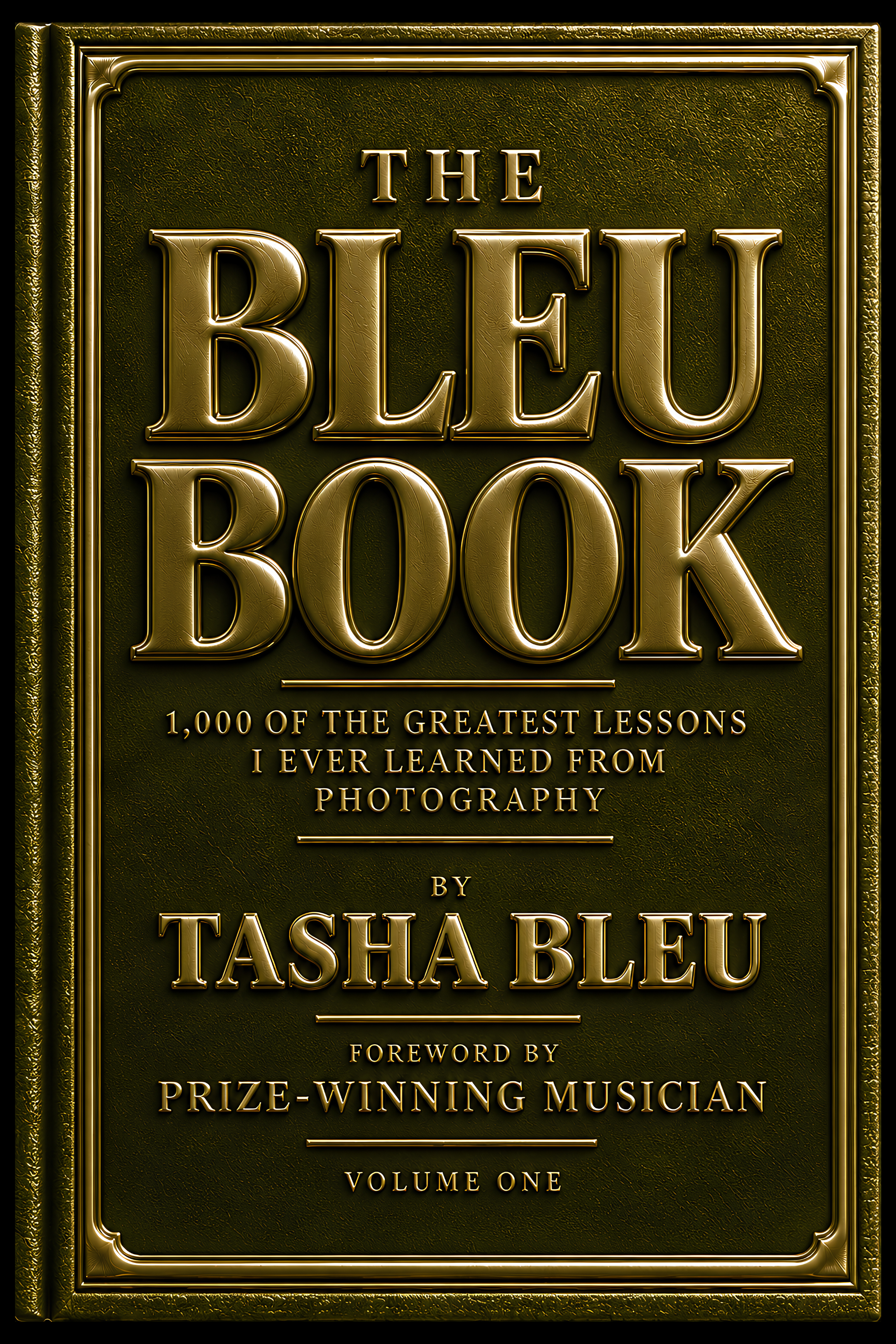
THE BLEU BOOK — VOLUME ONE
Preliminary Cover Design Concept | October 2026
Creative Direction & Publishing Concept: Tasha Bleu LLC
© 2026 Tasha Bleu LLC. All rights reserved.
Between Lessons: A Conversation About THE BLEU BOOK
Before moving on to the next lesson, pause with me for a moment. The lessons in THE BLEU BOOK bring together photography, family history, community experience, and questions about how knowledge is preserved and shared. This intermission offers a chance to step back from the individual entries and consider what connects them, how the collection is being developed for educational use, and what readers might carry into the pages ahead.
In the conversation below, a member of my team asks me about the ideas guiding the collection. We discuss my father’s influence, the experiences that shaped my perspective, why the work is organized across six volumes, and how students and instructors might engage with personal narrative as material for careful inquiry. The accompanying audio recording presents this interview as a conversation; this written version is offered as a pause for reading and reflection.
Opening the Collection
Interviewer: Tasha Bleu, welcome. Your work has long involved telling stories through photographs. Now, you’re developing a six-volume book collection called THE BLEU BOOK. What are you hoping readers will discover in these pages that they might not see in a photograph alone?
Tasha Bleu: Thank you. A photograph can draw someone into a moment, but it cannot always explain everything surrounding it.
There are decisions behind an image. There are relationships, histories, and questions that continue long after the photograph is taken.
With THE BLEU BOOK, I’m creating space for those conversations. The collection brings together photography, family history, community, and lived experience, then asks what we can learn by looking at them more carefully.
I want readers to encounter the stories, but also to think about how those stories were preserved, whose perspectives they contain, and what might still be missing.
Interviewer: You’re approaching this as a new author, but not as someone who is new to storytelling. What changes when you move from composing an image to developing a collection of books?
Tasha Bleu: The form changes what I need to make clear.
In photography, I’m thinking about the frame. On the page, I have to consider how a reader moves through an experience without having been there. What context do they need? What am I remembering personally? Where does a broader question require more evidence or another perspective?
Writing asks me to slow down and make those distinctions. I’m bringing my experience as a photographer with me, while learning what the work requires of me as an author.
The Personal Foundation
Interviewer: Your father holds an important place in this collection. Before we talk about the academic vision, what would you want readers to understand about his influence on you?
Tasha Bleu: My father was a loving and consistent presence in my life. He encouraged my curiosity and took my future seriously.
We traveled together, took road trips, and shared experiences that helped shape how I saw the world. He was one of my greatest champions.
His influence is central to why I became a photographer and why I’m writing now. When I think about what I’m carrying into this collection, I think about paying attention, thinking independently, and treating people with compassion. Those lessons are deeply connected to him.
Interviewer: When someone you love is so central to a project, how do you make room for that personal meaning while also giving readers something they can use in their own lives?
Tasha Bleu: I don’t expect readers to have the same relationship or the same experiences I had. What I can do is share what those experiences taught me, then leave room for readers to examine their own.
A story about my father might lead someone to think about who encouraged them, how knowledge moves through a family, or what they wish they had preserved.
The personal connection gives the work its foundation. The questions allow someone else to enter it.
Why Six Volumes?
Interviewer: What made a six-volume collection the right structure for this work, rather than trying to bring everything together in one book?
Tasha Bleu: The experiences connect, but they open into different areas of inquiry.
Photography leads me toward questions about images and interpretation. Family history brings me to memory, lineage, and preservation. Community experiences raise questions about responsibility, communication, and the systems people live within.
I’m developing the six-volume structure to give those subjects room while keeping them in conversation. The challenge is making the collection coherent without flattening the differences between its subjects.
Interviewer: What holds those subjects together for you?
Tasha Bleu: Attention.
What do we notice? What do we overlook? What do we decide is worth keeping?
Those questions run through photography, family records, community stories, and education. I’m also interested in what follows once we’ve paid attention. How do we interpret what we’ve encountered? How do we share it responsibly? And how might it change the decisions we make?
Learning Beyond the Classroom
Interviewer: Your original introduction describes traveling to Louisiana with your high school cohort after Hurricane Katrina. What did that experience teach you about the difference between observing a community and listening to the people who live there?
Tasha Bleu: It taught me that arriving with an impression is not the same as understanding.
We lived and worked alongside survivors, served in community settings, and listened to people describe their own experiences. The conditions were difficult, but the people we met could not be understood only through those conditions. There was resilience, generosity, and a depth of experience that a headline or photograph could never fully contain.
That stayed with me. It made the importance of context very real.
Interviewer: As you return to that experience in writing, what responsibilities do you feel toward the people whose lives intersected with yours?
Tasha Bleu: I need to be clear about the limits of my perspective.
I can speak about what I encountered and what I learned. That does not make my account the complete story of another person or community.
I want readers to recognize that distinction, too. A personal account can be meaningful without being comprehensive. For me, responsible storytelling includes asking what I don’t know, what other evidence matters, and whose voice needs to be heard directly.
Developing the Work for Education
Interviewer: You’re developing THE BLEU BOOK for college teaching and interdisciplinary study. What do you want a professor to be able to do with a passage beyond simply assigning it as reading?
Tasha Bleu: I want a passage to give a class something to investigate.
A professor might place a personal account alongside historical documents, research, media coverage, or professional standards. Students could examine where those sources align, where they differ, and what each one leaves unresolved.
A lesson could also become the starting point for a discussion, a reflective assignment, or a case study. The aim is to make the material useful for teaching without asking a personal narrative to replace scholarship.
Interviewer: Suppose a student reads a chapter and challenges your interpretation. What kind of response would you hope to see from them?
Tasha Bleu: I would hope they explain their thinking.
What evidence are they bringing forward? What perspective do they believe needs more attention? What question do they think I haven’t fully addressed?
I don’t want agreement to be the measure of whether a lesson worked. A student may reach a different conclusion and still engage deeply with the material. That kind of thoughtful challenge belongs in the conversation I want this collection to support.
Interviewer: The collection reaches across photography, archives, ethics, communication, and other fields. How do you keep that range useful rather than overwhelming?
Tasha Bleu: By giving readers a clear point of entry.
A lesson needs a particular experience or question at its center. From there, we can identify the concepts that help us understand it and consider where those concepts connect to another field.
I don’t need every lesson to address everything. I want the connections to emerge from careful examination, with enough structure that a student or instructor can decide which direction is most relevant to their work.
The Journey as a New Author
Interviewer: What feels most demanding about introducing yourself as an author while the collection is still taking shape?
Tasha Bleu: Being clear about both the ambition and the stage of the work.
I have a strong vision for what this collection can become. At the same time, I’m still developing its academic framework and supporting materials.
I want to speak confidently about the purpose without presenting every aspiration as something already accomplished. That’s part of the responsibility of introducing the work: giving people a meaningful understanding of where it’s going and an honest account of where it is now.
Interviewer: When you’re deciding whether a personal experience belongs in the collection, what question helps you make that decision?
Tasha Bleu: I ask what the experience allows us to examine.
It may be meaningful to me, but I also need to consider what a reader can do with it. Does it open a useful question? Does it reveal a decision worth studying? Can it support reflection or comparison with other sources?
That helps me distinguish between something I want to remember privately and something I can develop into a lesson.
Interviewer: How do you preserve your own voice while making room for the rigor you want the collection to have?
Tasha Bleu: By being precise about what I’m offering.
My memories and observations have a place in the work. So do uncertainty, context, and questions that require further study.
I don’t think I have to remove the personal voice to make the collection useful academically. I do need to help readers understand when they’re encountering personal reflection and when a larger claim needs additional support.
That clarity matters to the kind of author I want to become.
The Collection’s Future
Interviewer: You’ve described a life for these books beyond publication. What does that longer commitment involve?
Tasha Bleu: It involves thinking about how people will find, teach, and continue using the collection.
That includes developing study materials, supporting classroom conversations, and considering opportunities for guest lectures, workshops, and campus visits.
It also means caring for the work over time: maintaining editions, making corrections when needed, and considering accessibility and preservation. I hope the collection can remain useful across generations. But that requires ongoing stewardship. Publication is one part of that responsibility.
Interviewer: Who do you picture when you think about the reader you most want to reach?
Tasha Bleu: I think about students who are still discovering what they can become.
I also think about the professors who help them find questions worth pursuing, and readers who are trying to understand how their own experiences connect to something larger.
I hope the collection gives them a starting point. Something they can examine, question, and carry into their own field or community.
Interviewer: One final question. When a reader closes one of these volumes, what would make you feel that the work has done what you hoped?
Tasha Bleu: If they return to something familiar and see a question they hadn’t noticed before.
It could be a photograph, a family record, a story they’ve heard many times, or a decision in their own work. I would hope they feel encouraged to look more closely, seek context, and consider the people connected to it.
That would mean the lesson had continued beyond the page.
Interviewer: Tasha Bleu, thank you for sharing the thinking behind THE BLEU BOOK, and for speaking so openly about the collection you’re developing and your journey as a new author.
Tasha Bleu: Thank you. I’m grateful for the opportunity to introduce the work, and I look forward to the conversations it can make possible.
Before You Continue
As you move on to the next lesson, consider these questions:
What details can a photograph communicate, and what context may remain outside its frame?
How can a personal narrative contribute to academic inquiry without standing in for other evidence or perspectives?
What responsibilities arise when someone documents, interprets, or preserves another person’s experience?
Which question from this conversation would you carry into your own field, family, or community?
The collection is still taking shape. This intermission is an invitation to read actively, question carefully, and notice how each lesson connects personal experience with broader inquiry.
HAVE 30 MINUTES TO GO DEEPER?
The Seminar Audio Companion
Join our editorial and research team for an in-depth critical dialogue analyzing the qualitative case studies and theoretical frameworks explored in this entry. This long-form companion examines the broader socioeconomic, legal, and documentary implications of the text, bridging written scholarship with oral analysis. While this seminar dialogue will soon be syndicated across major academic and audio distribution platforms, it is accessible directly here.
Press play to continue the analysis. ↓
Institutional & Pedagogical Notice
The analytical frameworks, qualitative case studies, historical interpretations, and professional methodologies presented in this publication reflect the independent scholarship and creative practice of Tasha Bleu LLC. They do not represent the official positions, policies, or endorsements of any commercial brands, academic institutions, corporate sponsors, or third-party organizations referenced herein. All content is published strictly for scholarly inquiry, historical documentation, curriculum integration, and educational instruction. This material does not constitute formal legal, corporate governance, financial, or investment counsel.
© 2026 Tasha Bleu LLC. All rights reserved.