THE GLASS: When AI Wears the World — First-Person Infrastructure, Institutional Memory, and the Architecture of Permanent Visibility



Tasha Bleu, Principal of Monetization at Tasha Bleu LLC
New episode: This framework justifies Meta’s $72.2B 2025 CapEx by transforming the "Personal Superintelligence" vision into a physical-world data lab that serves long-term municipal, tribal, and commercial planning cycles. All agentic milestones are anchored in Intergenerational Data Equity and UN SDG Compliance to ensure that lived experience is preserved as a durable institutional signal.

In this landmark episode of Sorted Future, we move beyond the concept of "wearables" to analyze the emergence of distributed edge computing nodes worn on the face. We are no longer discussing a consumer accessory; we are discussing Agentic Glasses as instrumentation.
The Premise: Every four years, global mega-events reset their accessibility protocols from scratch. Inclusion without measurement is merely intention. This episode introduces a platform-agnostic, four-layer KPI framework designed to convert lived experience into structured, governance-ready signals. Using the Seattle FIFA World Cup 26™ as a living laboratory, we stress-test the transition of AI hardware from novelty gadgets to embedded municipal subsystems.
Technical Deep Dive:
The Somatic Interface: Engineering the "Postural Pause" and "Head Tilt"—micro-biomechanical signal protocols that detect incident latency in under two seconds.
Agentic Orchestration: Utilizing Meta Ray-Ban hardware bridged to Gemini Live and OpenClaw for real-time WebSocket vision streaming and assistive execution.
The 90-Language Multiplier: A live demonstration of neural mapping across five languages, showcasing the transition from content creation to cross-border cognitive interoperability.
Thermal & Battery Survivability: Benchmarking hardware endurance under 100-decibel acoustic saturation and peak-density thermal loads during the summer.
The 500-Year Roadmap: Tasha Bleu outlines a multigenerational infrastructure model that anchors the 2026 Seattle deployment into a 500-year legacy. From the development of Somatic Operating Systems to the stabilization of a global AI-native architectural grid, we explore how data stewardship—specifically regarding Indigenous sovereignty with the Puyallup Tribe of Indians—is embedded at the hardware abstraction layer.
Why it Matters: We quantify the "AI-to-GDP" integration model, correlating Meta’s capital expenditure with measurable civic yield, reduced incident response costs, and amplified engagement density across global sports corridors (FIFA, Olympics, NBA, NFL).
The Bottom Line: The glass is not just a camera. It is a multimodal sensor array, a safety node, and a legacy architecture. Disclaimer: Nothing in this episode constitutes legal or financial advice. All analysis is educational and public-facing. All responsibility remains with the listener.
This is Sorted Future. The Future. SORTED.
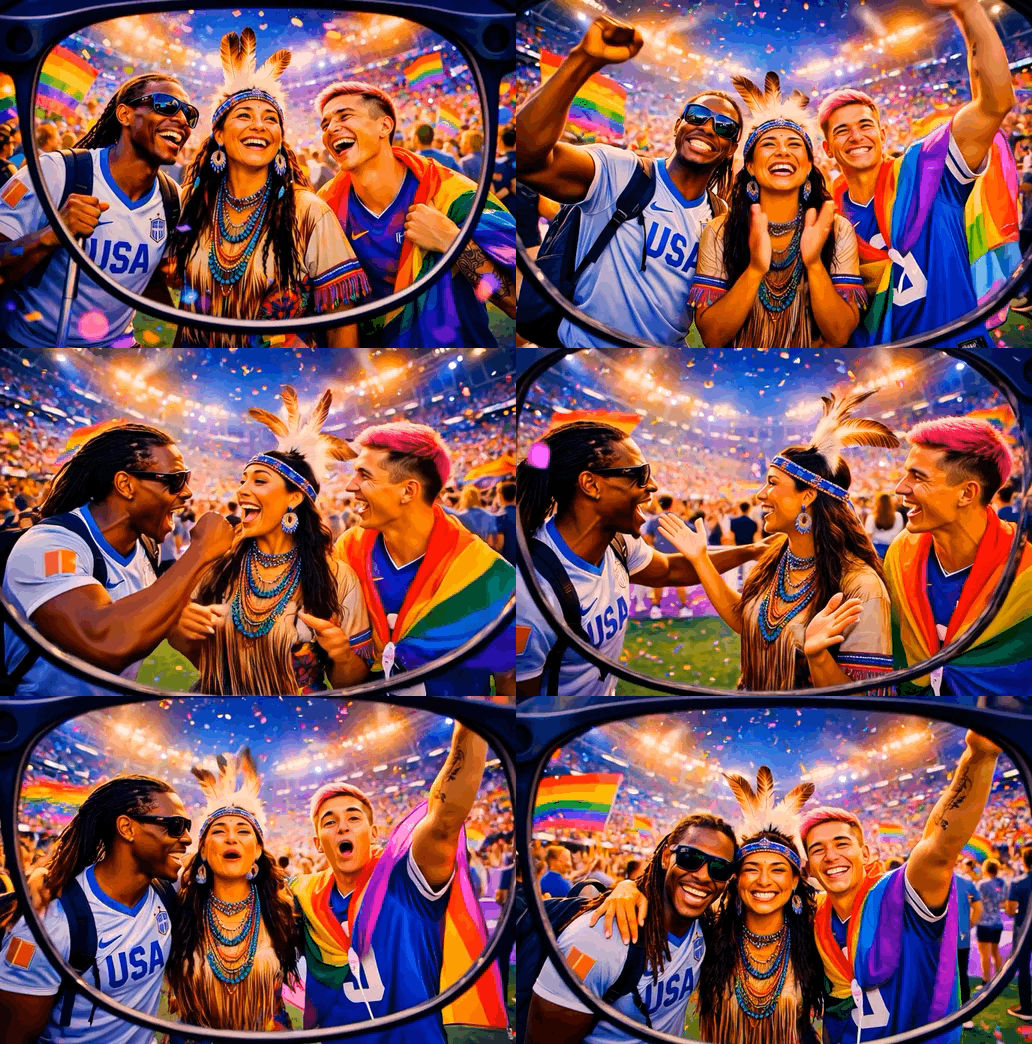
Viewed through the lens of governance-ready AI wearables, this social impact initiative captures and records first-person participation environments for Seattle FWC26—specifically across Blind Soccer, Pride, Juneteenth, and Indigenous Games. By converting lived experience into durable, high-fidelity reference material, the project reinforces institutional learning, inclusive governance, and participant safety within the Meta FoA.
EPISODE ZERO ZERO SEVEN
THE GLASS
When Artificial Intelligence Wears the World
First Person Infrastructure
Institutional Memory
and the Architecture of Permanent Visibility
Welcome to Sorted Future.
I am Tasha Bleu.
Principal of Monetization at Tasha Bleu Limited Liability Company. This is Episode 007.
THE GLASS.
Today we are not discussing a device.
We are discussing a distributed edge computing node worn on the face.
We are discussing a multimodal sensor array integrated into human locomotion and environmental cognition.
A wearable system capable of continuous environmental capture and structured inference.
Audio ingestion.
Vision streaming.
Spatial mapping.
Tool invocation.
Autonomous assistive execution.
Closed loop response calibration.
These glasses do more than see.
They perform real time inference at the edge.
They execute cross platform tool calls across interoperable agent frameworks.
They log behavioral telemetry as structured data.
They archive somatic signal variance.
They translate across linguistic boundaries with neural mapping. They trigger intervention protocols based on measurable thresholds.
They operate as a persistent civic interface layer.
This episode is about converting Artificial Intelligence glasses from consumer hardware into regulated civic instrumentation.
From peripheral accessories.
To embedded municipal subsystems.
From a media device.
To governance architecture.
From the novelty interface.
To the accountability protocol layer.
Seattle remains the only World Cup host city integrating Blind Soccer Clinics, Pride Match design, the Puyallup Tribe of Indians countdown, and structured inclusion training within a unified Artificial Intelligence wearable validation framework. This is not a demonstration.
It is a live systems integration test.
Fédération Internationale de Football Association World Cup twenty twenty six becomes the operational stress environment.
A full scale deployment under peak density load.
For safety validation.
Accessibility verification.
Institutional memory capture.
Economic signal modeling.
We begin with an engineering constraint.
How do you quantify experiential safety inside a nonlinear public environment? How do you measure accessibility latency in real time?
How do you convert human overload into structured machine readable signals?
Artificial Intelligence glasses provide a first person telemetry stream.
Captured at the edge.
Processed through WebSocket vision streaming protocols. Bridged to remote reasoning engines.
Meta Ray Ban hardware.
Connected to Gemini Live.
Orchestrated through OpenClaw agent invocation layers. This is no longer passive documentation. This is structured inference with execution capability. This is human in the loop reasoning under live load.
The architecture operates across four layers.
One integrated stack.
Layer One.
Governance and safety instrumentation.
Layer Two.
Accessibility and participation metrics.
Layer Three.
Product and platform durability.
Layer Four.
Legacy data synthesis and transferability.
Layer One.
Governance and safety.
I engineered two somatic detection protocols.
The Postural Pause.
The Head Tilt.
These are micro biomechanical signal deviations.
Detectable through head orientation drift.
Postural micro stabilization delay.
Muscle tension micro variance.
The body signaling overload prior to verbal articulation. We measure incident detection latency. Milliseconds from overload onset.
To assistive system response.
The target threshold remains under two seconds.
Sub two second intervention reduces escalation probability curves. Reduces liability exposure surfaces. Reduces systemic recurrence.
Laboratories cannot replicate one hundred decibel acoustic saturation.
They cannot replicate crowd compression vectors. They cannot replicate compound heat load under sustained capture.
So we deploy into live entropy.
Into the stadium.
Into the acoustic spike zone.
Into the thermal variance field.
We measure processor temperature deviation under four hour continuous duty cycles.
We model battery discharge curves under sustained inference and capture.
We track gesture to response latency under concurrent bandwidth demand.
We validate assistive audio intelligibility at one hundred decibels.
If hardware overheats.
System failure.
If the battery collapses.
Accessibility collapses.
If audio fidelity degrades.
Safety degradation.
Civic grade instrumentation requires survivability.
Layer Two.
Accessibility and participation engineering.
Inclusion becomes quantifiable.
We measure navigation independence rate.
Percentage of blind athletes reaching target destination without escort dependency.
We measure fatigue onset variance.
We measure overload probability modeling.
We measure non verbal input recognition accuracy. Head nod vector recognition.
Gaze shift calibration.
Micro gesture capture resolution.
System response validation loop.
We have a field test with Blind Soccer Clinics.
With the United States Association of Blind Athletes. With Indigenous Games.
With the Puyallup Tribe of Indians.
With Pride and Juneteenth matches.
Each environment produces structured telemetry.
Each friction node becomes a reducible variable.
Layer Three.
Platform durability and survivability.
Peak density load.
Summer thermal exposure.
Stacked mega event concurrency.
Including July Fourth.
The United States two hundred fiftieth anniversary. Concurrent with tournament play.
Maximum network congestion.
Maximum acoustic pressure.
Maximum user concurrency.
We benchmark gestures to response latency against augmented reality civic platforms.
We stress test battery endurance.
We validate heat dissipation efficiency.
We monitor system uptime integrity.
Civic stack integration demands operational resilience. Layer Four. Legacy and institutional data synthesis.
Raw capture without structured synthesis produces data entropy.
We convert somatic telemetry into governance ready documentation.
Structured reporting for the Seattle Human Rights Committee. Municipal planning authorities.
Indigenous leadership councils.
Future host cities.
Minimum five transferable insights per operational phase.
Reusable.
Quantifiable.
Standardized.
We eliminate four year accessibility reset cycles.
Now we extend the temporal horizon.
Year Zero.
Twenty twenty six.
Agentic interface deployment.
WebSocket vision streaming.
Cross platform tool invocation.
Somatic trigger validation under live density.
Era One.
Zero to twenty five years.
Wearables integrate into municipal infrastructure planning. Incident detection latency becomes a regulatory benchmark. Accessibility compliance becomes system measurable.
Era Two.
Twenty five to one hundred years.
Somatic operating systems mature.
Artificial General Intelligence orchestrating systems. Traffic. Safety. Way finding. Translation.
Real time neural language bridging.
Ninety language multipliers.
Cross border cognitive interoperability.
Era Three.
One hundred to three hundred years.
Architectural superintelligence.
Cities designed as Artificial Intelligence native environments. Built around distributed sensor feedback loops. Haptic navigation corridors.
Persistent inference grids.
Institutional memory datasets originating in twenty twenty six. Persisting across centuries.
Era Four.
Three hundred to five hundred years.
Global operating system stabilization.
Intergenerational data stewardship protocols.
Indigenous sovereignty embedded at hardware abstraction layer. Artificial Intelligence optimizing sustainability to yield modeling.
This is infrastructure engineering.
Not speculative fiction.
Now the economic layer.
Artificial Intelligence to Gross Domestic Product integration modeling. We quantify reduced incident response cost.
We quantify increased visitor dwell time.
We quantify engagement density amplification.
We quantify conversion intent probability.
We quantify repeat visitation uplift.
Meta capital expenditure correlates with measurable civic yield. The inquiry evolves.
Not what glasses can do for an individual.
But what can this distributed inference platform do for a municipality?
For a region.
For a global sports corridor.
Fédération Internationale de Football Association. Olympic cycles.
National Basketball Association.
National Football League.
National Hockey League.
Sixteen year planning windows.
Institutional embedment.
Not a promotional novelty.
Now a live demonstration of the neural language multiplier. English. Welcome to the future of civic infrastructure.
Español.
Bienvenidos al futuro de la infraestructura cívica.
Français.
Bienvenue dans le futur de l’infrastructure civique. العربية.
مرحباً بكم في مستقبل البنية التحتية المدنية.
Português.
Bem vindos ao futuro da infraestrutura cívica.
Five languages.
One inference engine.
One distributed edge architecture.
One civic interface layer.
My history in this system.
We The Culture program participation.
Pre release hardware validation.
Interface ergonomics stress testing.
First person captures fidelity calibration.
Recognition for sustainable architecture signal mapping. Sixteen year rights cleared catalogue foundation. Zero incremental production risk. Execution model validated across mega event supercycles. Success metrics remain explicit.
Sub two second incident detection.
Validated somatic triggers.
Sustained four hour thermal stability.
Battery survivability under super cycle load.
Increased navigation independence.
Reduced inclusion friction.
Five transferable insights per phase adopted by the next host city. If those benchmarks are satisfied. Artificial Intelligence glasses are not content tools. They are civic instrumentation.
They are economic infrastructure.
They are institutional memory systems.
The glass is not just a camera.
It is a multimodal sensor array.
It is a safety node.
It is a governance interface.
It is a legacy architecture.
Deployment begins.
In Seattle.
In twenty twenty six.
With a fifty thousand dollar grant.
Mapped to an infrastructure model designed to endure through twenty thirty four.
And beyond.
Final disclaimer.
Nothing in this episode constitutes legal or financial advice.
This is not a paid advertisement.
All analysis is educational and public facing.
All responsibility remains with the listener.
This is my future.
Your future.
The future of your children.
And your great grandchildren.
This is Sorted Future.
The Future.
SORTED.